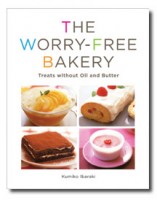
 The Worry-Free Bakery
by Kumiko Ibaraki
Vertical, Inc.
$14.95
This isn’t really a review, because I feel a real cookbook review should include recipe testing, but Vertical sent me this book this week and it piqued my interest.
The idea behind the book is that everything in it is made without added oil or butter. However, the author does use full-fat milk and yogurt as ingredients. This is buried in the back of the book, but it needs to be emphasized, because most people nowadays use low-fat milk and yogurt. When a recipe just says “milk,” I reach for the 1% milk, which is the only kind I regularly keep on hand.
That wouldn’t work for these recipes. Baked goods must have some fat so they don’t become dry. While the distinction seems semantic—the author is not adding oil or butter, but there is fat in the other ingredients—the finished recipes are still lower in fat than standard versions because even whole milk and yogurt have less fat than the oil and butter they are replacing. The book gives the number of calories for each item as well as the calorie count for the full-fat version, but there is no further analysis. You would think a comparison of fats would be relevant, but I suppose the calorie counts are evidence enough that the fat is reduced.
The items in the pictures certainly look tempting—if you enjoy food porn, this book is probably worth buying for that reason alone. It’s hard to believe that you could make New York-style cheesecake, palmiers, apple pie, or napoleons without added butter or oil, and even harder to believe that the results would be edible, but the photos make a convincing case.
The recipes don’t rely on any oddball techniques, as low-fat recipes often do; they are not that different from regular recipes. However, the measurements were all translated directly from metric, which results in some odd amounts—I have a lot of equipment, but there’s no 1/5 teaspoon or 1/5 cup measure in my kitchen. Since measurements are given in weight as well (the most reliable way, most serious bakers agree), I can just use my kitchen scale, but without it, I’d be lost. Also, many of the recipes call for a small amount of an odd ingredient—1 tablespoon of condensed milk, for instance—so if you don’t have any use for the rest of the can, it’s a bit wasteful. For these reasons, I think the book is best suited for experienced bakers.
Is it healthier? That depends on your definition of “healthy.” I do quite a bit of baking at home—we make our own bread, and I make scones, muffins, cookies, cakes, and the occasional pie for family consumption. I enjoy baking, but I also feel strongly that the things I make myself—even indulgences like pie and chocolate cake—are healthier than store-bought. I use mostly organic ingredients, and whenever possible I use canola oil instead of butter because of its healthier fat profile.
While the recipes in The Worry-Free Bakery probably are lower in fat than my standard recipes, they also substitute saturated fats (in the milk and yogurt) for the monounsaturated fats in my canola oil. Which is healthier? It’s hard to say, and in fact it probably varies with the individual. It’s just something to think about. Similarly, the carb content may be higher in some of these recipes, which will affect different people differently.
On the other hand, I like the idea of using whole milk and yogurt. There’s a philosophy of healthy eating that holds that foods are best taken in their natural form, as opposed to separated foods like low-fat milk (or butter, for that matter). It may be as much aesthetic as scientific, but lots of people are drawn to that philosophy. Ibaraki uses a lot of separated foods as well—most of the recipes call for cake flour* and various starches—but if the techniques in this book work, I would consider adapting them to my heartier recipes that do use whole grains and natural sweeteners.
And that’s the real value of this book. Despite the low-fat talk, it’s really just a different way of baking, and the real test is whether the results are worth the calories. I would rather have a small slice of real chocolate cake than a big slab of some low-fat version, so I don’t bother with modified recipes unless the end product is good enough to stand on its own. That’s why it’s OK with me that this book calls for whole milk and yogurt; if it didn’t, I’d be suspicious. This is by no means a beginner’s book, but for those who are looking to expand thei repertoire, it looks like a good bet.
*This is a standard low-fat baking trick—cake flour is lower in gluten than all-purpose flour, so it makes more tender cookies and pastries. I use it in sugar cookies and it works a treat.
(This non-review is based on a complimentary copy supplied by the publisher.)

This is clearly not a book for me, partially because I am not that fond of baking (I love the frying pan). I have to heartily agree that it’s better to eat a little of something totally delicious than to eat a lot of something slightly “healthier” that is less satisfying. I also see higher caloric content, at least in some situations, as a good thing. The more calories one food item has, the less I need to eat for the rest of the day, as long as there is some balance between different kinds of foods.
Pingback: The Manga Critic » Blog Archive » Monday Linkblogging, 10/5/09
Ed started busting my chops for using canola oil once; apparently there’s a whole “canola oil is bad for you” conspiracy, but I chalk that up to Ed being from San Francisco.
As you may or may not know, I’m a Weight Watchers person, so for me fat content is important, but calories are king. If I can have pie for 4 Points instead of the usual 9, I’m really happy.
Good call on the whole milk note – I might have made a couple of disastrous souffles without reading it!
Erin, I have heard various things about canola oil as well, including dark suspicions that nut and seed oils are bad for you and fats from meat and milk are more “natural.”