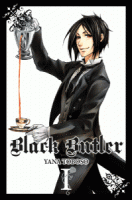
 Black Butler, vol. 1
By Yana Toboso
Rated OT, Older Teen
Yen Press, $10.99
Black Butler is set in Victorian, or maybe Edwardian, England, but anyone who is looking for a male version of Emma will be sorely disappointed. This is really an action story, and by the second half of the book—when the car chases begin and the characters all whip out their cell phones—all pretense of period elegance is gone.
The problem is that there is no action in the first half of the book. It’s all about Sebastian, the perfect butler, pleasing his 12-year-old boss, Ciel Phantomhive, with his superhuman butlering skills. This is made difficult by the fact that the rest of the household staff is bumbling idiots, a setup that the creator is desperately trying to play for laughs. It doesn’t work; the staff are too exaggerated and shrieky, and the pratfalls quickly become monotonous.
Ciel is apparently the last remaining member of the Phantomhive toymaking dynasty. He lives alone, except for his household staff, in his enormous, luxuriously appointed mansion, and he alternates between whining and lounging around looking bored. He’s your basic affectless manga guy, and he is the least interesting character in the first half of the book. You would think a toymaker would have some interesting toys scattered around the place, but all Ciel has is a generic boxed board game that serves as a plot device but has no entertainment value of its own. Instead, the focus is on the household staff, with the butler obsessing about the garden and the food and everyone else getting in the way.
The first half of the book should be setting up the story and providing some context. Who is Ciel? Why does he wear an eyepatch? What happened to his parents? Is there something sinister about his family’s toymaking business? Has something terrible happened to the rest of his family? These are things the reader wants to know, but we get no answers, just more poorly drawn teacups and mutterings about poached salmon. Then his childish girlfriend shows up and dresses everyone in frills and bows, throwing tantrums to get her way. Halfway through volume 1, there has been zero plot exposition, but the annoying side details have reached critical overload.
And then, a few pages into chapter 3, after another slapstick scene in which the household staff spazzes out about mice, the whole story starts to change. Suddenly Ciel is playing pool with adults and practicing a little extortion as well, in exchange for getting rid of … someone. Everyone speaks in metaphors, so it’s hard to say who. Then there’s more business with pastries and dropping the china before the book takes a final lunge in the opposite direction: Ciel is kidnapped and beaten, and Italian mafia guys threaten to kill his household staff because apparently Ciel has stolen some drugs from them. Then there’s a lot of yelling and speedlines and eventually Sebastian shows up and kicks everyone’s ass with some slick moves, including a cool Wolverine thing with the cutlery (which, sadly, shows the sort of potential this book would have if the author had tried a little harder). But wait! There’s a Sinister Secret! Ciel and Sebastian have a special bond, and Sebastian is no mere mortal butler, which of course comes as no surprise—it’s the sort of thing you expect to happen in this sort of book, even if the creator has neglected to foreshadow it at all. The end of the book is only marginally more coherent than the beginning, but at least the characters seem to have some motivation and the story is morphing into an action/revenge kind of a thing.
Black Butler has the makings of a great story, but it’s never really realized. The toys, for instance, could have been exploited for atmosphere, and toys are much more sinister than pastries and tea sets. The first two chapters are just floating out there with no context; if Toboso had used them to fill in some of the backstory, they would have been a lot more compelling. As it is, the Victorian schtick has an off-the shelf feel to it, and the whole Upstairs, Downstairs thing is so poorly executed that it detracts from the main story.
The book’s one redeeming feature—and it gives me hope for volume 2—is the way Sebastian totally kicks ass in the last chapter. Toboso’s artistic weakness—his figures are too thin and insubstantial—becomes a strength when Sebastian starts swinging from the ceiling and delivering kicks to the face. There is a nice, dynamic feel to those last pages that is totally missing from the beginning.
Dedicated shonen fans who like slapstick and prefer ass-kicking to narrative will probably enjoy this first volume more than I did, but I’m willing to stick with the series to see if it gets better in the long run.
End note: I read Lianne Sentar’s review of the anime, and if you don’t mind spoilers, you should check it out, if only for her excellent descriptions of what went wrong. Like this:
Unfortunately, most of the comedic potential is wasted on a bevy of side characters who couldn’t be less funny if they were gassing kittens, and the homoeroticism between Sebastian and his pre-pubescent charge is definitely more disturbing than amusing.
Yup. But here’s the thing: Lianne likes the story, and she explains that the anime gets better as you go along. Hopefully the same will be true of the manga.
(This review is based on a review copy supplied by the publisher.)