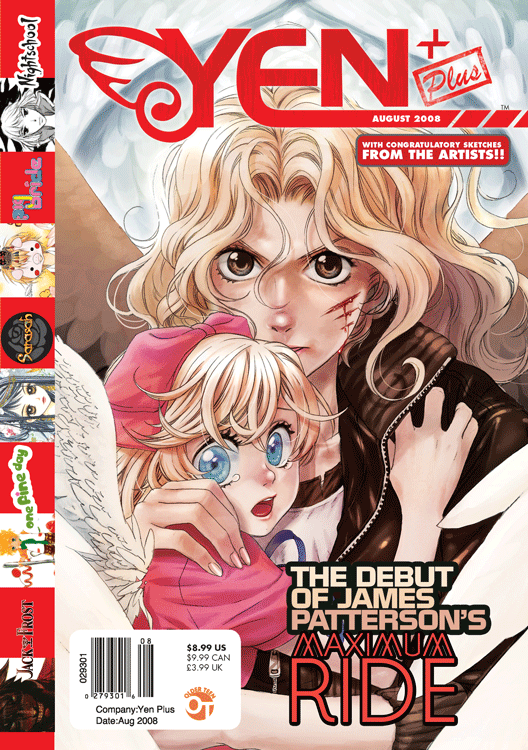
 Yen+, August 2008
Published by Yen Press
Senior Editor JuYoun Lee
Rated OT, for Older Teen
About 450 pages, $8.99
Yen+ is good. It’s beautifully produced, with attractive covers and plenty of extras. The manga look really good on the larger pages, and the Yen folks have picked a wide variety of very readable manga for this debut issue. I do think the lineup is flawed, but we’ll get to that in a minute.
Let’s get the inevitable comparisons to Shonen Jump and Shojo Beat over with right away. Yen+ has a slightly smaller trim size than the same trim size as those two, but it’s still big enough to make for a noticeably better read than the standard volume of manga. It’s thicker but also more expensive. It has no extra articles on fashion, music, or Japanese culture, as Shojo Beat does, but this first issue carries lots of pieces of congratulatory art by the manga creators.
Here is the big point of divergence, though: Shonen Jump and Shojo Beat carry manga with different storylines but a pretty consistent style and tone, and I have always imagined that Japanese manga magazines run along similar lines. Yen+ has a much wider variety of stories, and that is both a strength and a weakness. On the one hand, the reader gets to sample a wide range of stories, but the downside is that the magazine seems unfocused, not aimed at any particular reader.
This first issue starts with two global manga that are guaranteed crowd-pleasers, Maximum Ride, based on the novels of James Patterson, and Nightschool, by Svetlana Chmakova, of Dramacon fame. Both have lovely art and show a lot of promise, but to be honest, one chapter isn’t enough of either one. Maximum Ride starts out by introducing us to a slew of characters who have some obvious peculiarities and tosses in some action right away, but by the end of the chapter I still wasn’t too sure of what was going on. The story revolves around some teenagers with various special powers, and some bad guys who are their enemies, but its not at all clear how it all fits together. (I like it that Patterson chose a strong woman, Max, as his main character, but I wasn’t crazy about the moe-esque little girl Angel.)
With Nightschool the problem is not so much the basic premise, which is pretty clear, but the sheer number of characters who are introduced all at once. Again, it’s hard to tie it all together and see where the story is going. This is the biggest limitation of the anthology format—there isn’t enough space to lay the whole story out in a single chapter. Still, the bottom line is that I want to know more about each story, and after all, I think that’s the point.
Next come a couple of very standard-issue manhwa. Pig Bride is a supernatural love story with mythic overtones, Sarasah starts out like unrequited-love shoujo manga but takes an odd turn right at the end. Both are worth a look, and I might not have picked them up on their own. Well played, Yen Press!
One Fine Day is a slice-of-life manhwa about a guy doing ordinary things with his three companions, a cat, a dog, and a mouse, all of whom morph into little kids in animal costumes. It’s a little odd, but Yen+ is actually a very good showcase for it, as the bigger pages allow creator Sirial’s spare layouts to really breathe.
So, we’re cruising along with lots of pretty manga and manhwa, and I’m feeling pretty good about Yen+ at this point, and then I turn the page and suddenly the whole tone changes with Jack Frost, a splatter manhwa that features pages and pages of a girl’s decapitated head looking at her kneeling body, panties on full display, while some sort of fight goes on in her classroom. This manhwa is all kinds of bad. It mainly centers on some sort of fight, but we don’t really know who’s fighting or why. The girl has just been decapitated and the lower part of her body arranged in a sexually suggestive position (we get several tight shots of that so we won’t miss it) but her biggest concern is that she can’t see one guy’s face. (You would think that the artist, having made that a plot point, would conceal the face from the reader, but he doesn’t.) It’s a little hard to imagine the reader who picked up Yen+ for Nightschool or Maximum Ride enjoying this story. It seems like it’s pitched to an entirely different reader, and I think a lot of readers will find it off-putting—just as the reader who buys Yen+ for Jack Frost may very well find Pig Bride a turnoff.
At this point the magazine flips, and the four manga stories are read right-to-left. The Yen folks do a nice job of making this a smooth transition. Of the four manga, Soul Eater pretty much matches Jack Frost in terms of gore and fanservice, but the other three manga are all pretty readable. They are all action-oriented but not incongruous in this setting. I was all set to hate Higurashi When They Cry, but I ended up liking it a lot—think Kindaichi Case Files meets Aoi House, with an extra sprinkling of weird. Again, I ended up liking a manga I wouldn’t have picked up on my own.
I know that an anthology is supposed to have variety, but I think the editors of Yen+ have cast the net a bit too wide. The differences in tone as well as content are likely to turn off some prospective readers. On the upside, this is a great choice for people who like to read a lot of different genres. The stories are strong overall, and the design and production are top-notch. Yen+ feels like a quality magazine, and I’m looking forward to the second issue already.
(Full disclosure: This review is based on a complimentary copy supplied by the publisher. The toner of Nightschool, Dee Dupuy, is a friend of mine, and I have socialized with Svet as well. They both collaborated on the Toning 101 primer I ran in MangaBlog recently. And I occasionally freelance for Shojo Beat.)