Review: Dororo, vols. 1 and 2

Dororo, vols. 1 and 2
By Osamu Tezuka
Vertical, Inc., $13.95

If Viz published Dororo, they would put the scrappy title character front and center, fists flying as he dispatches yet another evil spirit. But this edition is published by Vertical, purveyors of fine classic manga for adults, so the covers of these two volumes look like they were designed by Joseph Cornell—if Cornell had had access to neon inks and spot varnish.

At its heart, though, Dororo is a shonen manga. The two main characters are knit together in a grudging friendship. They travel through samurai-era Japan, encountering all sorts of enemies, from spirits of dead babies to wicked feudal lords, and dispatching them all with a combination of skill and ingenuity. And along the way they come to terms with the circumstances of their lives and find a purpose for their wanderings.

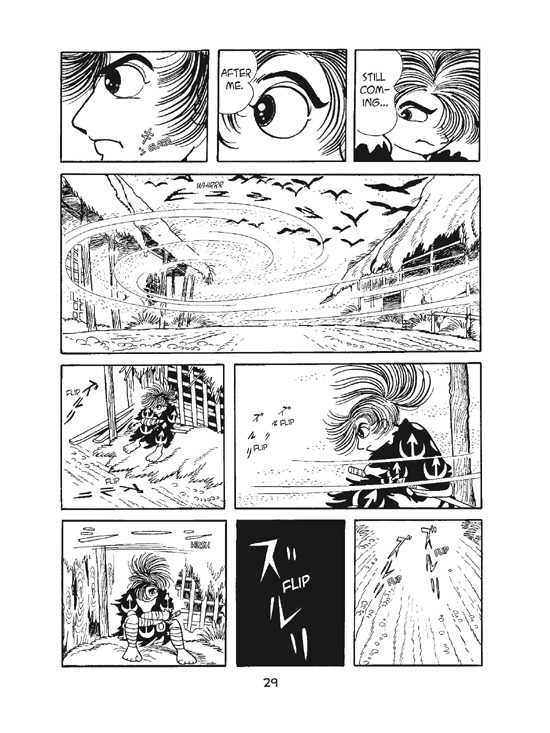
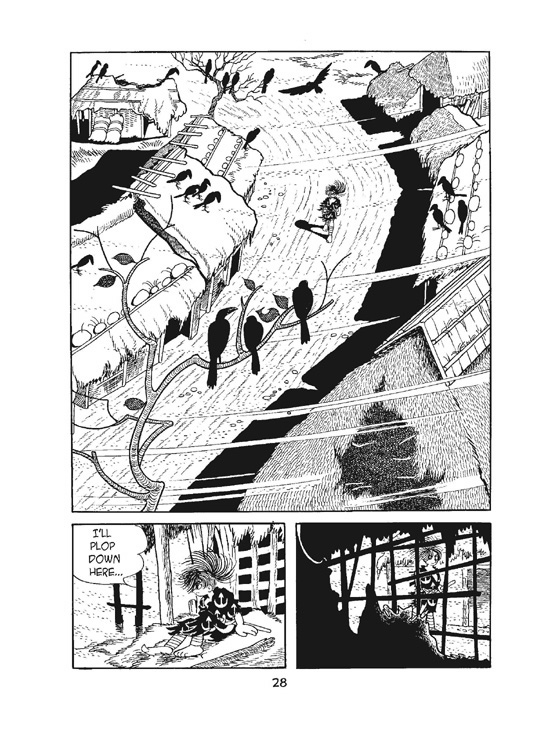
What lifts Dororo above the ranks of the humdrum, of course, is Tezuka’s storytelling and his art. I know we’re all supposed to like Tezuka because he’s the godfather of manga, but often I find his work awkward and overly stylized. Not this time. He stretches his panels out to accommodate a whistling wind or a swarm of snakes; he zeroes in on a figure, a face, an eyeball; he depicts sweeping landscapes and interior states of mind with the same attention to detail. This is a book worth buying for the art alone.
Hyakkimaru, the main character, has had a most unfortunate beginning. Before he was born, his father, an evil nobleman, cut a deal with 48 demons: He gives each of them a part of his unborn son, and in return, he becomes the ruler of the land. Indeed, Hyakkimaru is born blind, deaf, and limbless and at his father’s command, his mother sends him off down the river in a basket to die. In typical manga fashion, he is rescued by a wise old man who comes to love him as a son and who fashions prosthetics to replace his visible missing parts. Handily enough, the prosthetics all double as weapons—his arms are swords, his fake leg shoots out caustic powder, even his false nose contains an explosive. Hyakkimaru is blind and deaf but has strong intuition that not only replaces those senses but also allows him to sense the presence of spirits of the dead, who seem to follow him everywhere.

Hyakkimaru’s traveling companion is Dororo, a little kid whose most compelling characteristic is his ability to absorb horrific beatings and keep on going. Dororo is scrappy and selfish, which is not surprising once we learn his backstory, but he also has great compassion for those who are beaten down by life. Hyakkimaru is older, wiser, and more skilled, but still not sure of himself or where he is going, at least at first. His journey gains meaning as he proceeds, and each time he defeats a demon, he wins back one of his missing body parts, becoming whole literally as well as metaphorically.

Dororo is very episodic: The two characters meet their enemies one at a time, and each encounter is different from all the others. Hyakkimaru is a skilled swordsman who relies on his intuition as much as his bionic weapons. Dororo gets by on sheer grit and a complete lack of respect for any authority. Tezuka comes up with an imaginative array of foes: A god who steals his victims’ faces, a feudal lord who kills anyone who crosses his border, a moth-woman who kills to preserve her secret. The stories are different enough that the book never feels repetitive or formulaic, and as these two volumes progress, Tezuka reveals more and more about his characters, so Dororo is more than just a collection of adventures, it’s a real story.

What is rather jarring is the juxtaposition of brutality and cuteness. Dororo is rounded and adorable; he could have stepped out of a Betty Boop cartoon or a classic Disney movie. He acts like a cartoon character as well, all double-takes and exaggerated gestures. So he doesn’t look right next to a firing squad, and when he calls a nobleman who has just killed two children a “poop snake,” it doesn’t really sit well. There is a lot of graphic violence in this book, and the fact that most of the victims have cartoony features doesn’t mitigate it. This isn’t Wile E. Coyote getting hit on the head with a giant hammer; it’s parents being shot with arrows as they plead to see their children one last time, or innocent workmen being beheaded so they won’t betray the details of their project. Less unsettling is the revelation that Dororo, whose feistiness is played mostly for laughs, has a sad backstory; that does seem to fit with the character.

Dororo was first published in 1968, and the art does look a bit dated. Hyakkimaru’s wild hair, Dororo’s chubby features, and a cast of characters that look like Asterix extras in Japanese costumes take a bit of getting used to. Unlike many modern artists, though, Tezuka pays attention to detail, and the backgrounds and settings are often breathtakingly beautiful. His battle scenes are staged with attention to the psychological tension as well as physical action, and his depictions of supernatural creatures, even the repulsive ones, are fascinating. Undergirding all this is a panel structure that really serves to move the story along: huge panels setting the scene, quick actions or turns of mind chopped into small squares alongside a vertical panel that shows the context, horizontal panels stretching across the page to slow down the action at the end of a movement. This is a book well worth buying for the art alone.
Vertical, of course, gives this book the star treatment, with creamy, high-quality paper and covers that won’t make adults embarrassed to carry this book in public. There is one problem, although it’s obvious only on close examination: All the lines and even the lettering in the balloons have a slight stairstep effect, to them, as if they were shot through a screen. The early pages of vol. 1 are also marred by some moiré in the screen tones, but as Tezuka doesn’t use much toning, this only occurs in a small part of the book.

Although it probably will never sell in Naruto-like numbers, I’m glad Dororo isn’t printed on newsprint with a scrappy Dororo kicking someone on the cover. Tezuka’s art and storytelling skill make Dororo a delight to read, a good example of a classic that deserves to be a classic, and Vertical’s presentation only enhances that.

This review is based on complimentary copies provided by the publisher. Images copyright (c) 2008 by Tezuka Productions and taken from the Vertical website.

Amazon.com Widgets

Posted in Reviews | 4 Comments

Top manga for June

ICv2 has published Diamond’s top 100 graphic novels for June, that is. Here’s the manga list. As always, the first number in parentheses is the book’s ranking on the overall GN list, the second number in parentheses is the number of copies sold by Diamond, which mainly distributes to comics stores.

1. (17) Bleach, vol. 23 (4,163)
2. (31) Blade of the Immortal, vol. 19 (2,989)
3. (32) Path of the Assassin, vol. 11 (2,886)
4. (33) Negima, vol. 18 (2,886)
5. (38) Gantz, vol. 1 (2,749)
6. (48) Vampire Hunter D, vol. 2 (2,226)
7. (67) .hack//XXXX, vol. 1 (1,883)
8. (75) MPD-Psycho, vol. 5 (1,761)
9. (78) Battle Vixens, vol. 13 (1,707)
10. (84) Rosario x Vampire, vol. 1 (1,585)
11. (88) One Piece, vol. 18 (1,526)
12. (89) .hack//G.U.+, vol. 2 (1,521)
13. (94) Apple, vol. 1 (1,414)
14. (98) Oh My Goddess, vol. 9 (1,380)
15. (99) Welcome to the NHK, vol. 7 (1,380)

Were the girls all at the beach last month, or were they just buying in Borders? With no Bleach or Fruits Basket in June, all the manga place pretty low on the list, and it all looks like the type of thing that would appeal to readers of other comics, i.e., battles, violence, games, and a bit of fanservice. ICv2 analyzes the overall comics market for June here.

Posted in Mangablog | 3 Comments

Quick Monday roundup

Newsarama’s Benjamin Ong Pang Kean continues his series on manga with a look at what the future may hold.

Here’s an interesting paper by an Australian college student on the popularity of manga outside Japan. And hey, we’re included in the footnotes!

Should manga reviewers stick to specific genres? Tiamat’s Disciple says no, and I’m inclined to agree.

At Rocket Bomber, Matt Blind summarizes online manga sales and looks at the top 500 manga for the past week, then turns the spotlight on Dark Horse and looks at their manga sales.

Japanese computer engineer Sindharta Tanuwijaya writes about about a manga he discovered on the topic of refugees.

Chloe Ferguson and Lissa Pattillo weigh in on Tokyopop’s beta website. General consensus is that it’s better than the current one but still could stand some improvement, and Chloe was startled to see Amazon links to buy books from other publishers (although presumably Tokyopop is getting a cut).

Comic-Con is almost upon us, and Deb Aoki helpfully provides ten survival tips and provides a sneak peek at Fanfare/Ponent Mon’s offerings at About.com. At Same Hat! Same Hat!!, Ryan and Evan outline their SDCC plans, which include lots of time at the Last Gasp booth promoting Tokyo Zombie. At Okazu, Erica Friedman is already thinking ahead to Otakon and MangaNEXT, where she hopes to get a yuri circle together in Artists Alley.

At The Star of Malaysia, Makoto Fukuda looks at the friction between Zatch Bell creator Makoto Raiku and his editors.

Japanator’s Dick McVengeance has some tips for learning Japanese.

Reviews: Mangamaniac Julie reviews A Love Song for the Miserable and Ed Chavez has a video and audio review of vol. 2 of Dororo at the MangaCast. Over at the Manga Maniac Cafe, Julie check out vol. 2 of Two Flowers for the Dragon. Lissa Pattillo reviews vol. 1 of Fairy Cube at Kuriousity. At Slightly Biased Manga, Connie reads vol. 4 of One Thousand and One Nights, vol. 10 of Pastel, vol. 5 of Bastard, vol. 20 of Fruits Basket, and vol. 21 of Astro Boy. Kazu Kibuishi not only liked Tekkonkinkreet, he found it inspiring (via Comics212). Tiamat’s Disciple reviews the light novel vol. 4 of Vampire Hunter D: Tale of the Dead Town. Kransom posts some brief manga reviews, including Me and the Devil Blues, at welcome datacomp.

Posted in Mangablog | Comments Off on Quick Monday roundup

Potpourri

Danielle Leigh explains why she likes CMX in her latest Manga Before Flowers column, and I’m with her—I love their classic shoujo titles and the newer stuff as well.

OK, all you who have been complaining about the Tokyopop website, time to do something about it: the beta version of their new site is up. Go, look, make suggestions.

NPR discovers Americans’ love of graphic novels, with plenty of nods to manga.

Back in the day (i.e., last year), YaoiSuki was the best yaoi blog out there. Now it’s gone, but ComiPress talks to bloggers Jen Parker and Jordan Marks about their site and why they called it quits.

Tiamat’s Disciple has some thoughts on light novels, including what we should be calling them.

Reversing the usual order of things, Kodansha will be publishing Dan Pink’s Johnny Bunko: The Last Career Guide You’ll Ever Need in Japan.

At Okazu, Erica Friedman rounds up the yuri news of the week.

Jason Thompson discusses possible reasons why most global manga is influenced by shoujo rather than shonen manga. Readers respond in the comments section.

John Jakala discovers the original omake, and it’s not what you think.

Youka Nitta is out, but the new Yaoi-Con guest will be Pet on Duty creator Nase Yamato.

Rejected Olympics manga coming soon! No, I don’t know what it is either, but I’ll probably check it out on Monday.

Here’s the PR on an “American-style manga series”—did you ever think you would see that phrase?—which is conceived by an American, written by a Scot, produced in the Philippines and “programmed,” whatever that means, in China. Actually, this looks suspiciously like one of those companies that uses comics as a means to an end, in this case, creating a virtual world. But they’re savvy: They have a DeviantART page and a blog.

The Wareham, MA, Courier looks at a Borders concept store that features manga and other comics—and hired a former comics retailer as well.

UK writer David Rasmussen has put together an e-book of older interviews he did with Tokyopop folks for the Anime Boredom website. It’s 99 cents at Lulu.com. And here’s his interview with Kat and Mouse creator Alex de Campi at Pop Syndicate.

OT, but of interest to many of us: Time Magazine interviews moot, the founder of 4chan.

Reviews: Tom Baker takes a look at Sakura Taisen for the Daily Yomiuri. Nerdtron enjoys 100% Perfect Girl at Nerd Fellowship. Connie reads vol. 13 of Swan at Slightly Biased Manga. Kransom at Welcome Datacomp reviews two of Frederick Schodt’s books, Manga! Manga! and Dreamland Japan. Eric Turner checks out vol. 2 of Black God at Manga Jouhou. Leroy Douresseaux looks at vol. 12 of xxxHOLiC, vol. 2 of Fairy Cube, and vol. 1 of Kasumi for The Comic Book Bin. Malcontentcontent isn’t made any happier by the light novel Missing. Emily checks out two more unlicensed manga, Otomegokoro and Kimi ga Suki, at Emily’s Random Shoujo Manga Page. Ferdinand enjoys vol. 1 of Kasumi and vol. 1 of Silver Diamond at Prospero’s Manga. At Comics Worth Reading, Johanna Draper Carlson deems vol. 1 of Two Flowers for the Dragon to be best suited to those with short attention spans. Julie reviews vol. 2 of Dororo and vol. 9 of D.Gray-Man at the Manga Maniac Cafe. Lissa Pattillo enjoyed Fallen Moon despite the fact that it’s barely BL at Kuriousity. Sesho posts text reviews of vol. 2 of Psycho Busters and vol. 6 of GTO and a podcast review of vol. 1 of Yggdrasil. Tiamat’s Disciple looks at vol. 2 of Rurouni Kenshin, the VizBig edition, and vol. 3 of Vampire Hunter D: Demon Deathchase. Fashionista Piranha discovers The Four Immigrants manga. Simplicity enjoys vol. 1 of Strawberry Panic, the light novel. Bill Sherman reads vol. 5 of The Drifting Classroom at Blogcritics.

Posted in Mangablog | 9 Comments

SDCC: Street Fighter will be there

Looks like Udon will have a boatload of Street Fighter books and other merch at SDCC. Read on for details.

UDON BRINGS THE STREET FIGHTER® GOODS TO THE SAN DIEGO COMIC-CON
Exclusive Street Fighter® Comics, Hardcover Art Book and Art Prints at SDCC

Toronto, ON – July 17, 2008 – The 2008 San Diego Comic-con is only a week away, and UDON is preparing for the studio’s biggest year ever. Come celebrate Street Fighter®’s 20th Anniversary with an all-new hardcover art book, exclusive art prints, and the return of new Street Fighter comics with 3 exclusive covers!

UDON’s featured item is the Street Fighter Tribute limited edition hardcover. Featuring 320 pages of all-new pinup art celebrating the Street Fighter franchise’s 20th anniversary, this gorgeous art book includes pieces by such greats as Adam Hughes, J.Scott Campbell, Mark Brooks, Sean “Cheeks” Galloway, Bobby Chiu, Bryan Lee O’Malley, Penny Arcade’s Gabe, Arnold Tsang, Alvin Lee, and hundreds more!

Also tying into Street Fighter Tribute, UDON will have exclusive art prints for sale of select Tribute art pieces. Contributing artists will also be selling prints of their own tribute pieces at their booths all over the convention.

For those fans who have been patiently waiting for new Street Fighter comics – the wait is over! SDCC is the launching point for Street Fighter Remix #0. This all-new prelude comic features three stories by Omar Dogan, Jeffrey “Chamba” Cruz, and Joe Ng, each of which leads into one of UDON’s three new Street Fighter comic series. Fans attending the con will have their choice of not 1, not 2, but 3 convention exclusive covers, featuring the iconic Ryu, the sexy Chun-Li, or big brawler Alex! The new Street Fighter comic stories all begin here, so be one of the first to get in on the action!

As always at the UDON booth, you’ll be able to get autographs and sketches from your favorite UDON artists, pick up art books, trade paperbacks, manga and posters, and get the latest scoop on the studio’s newest projects! Drop by Booth #5368 and celebrate 20 years of Street Fighter with UDON!

Posted in Mangablog | Comments Off on SDCC: Street Fighter will be there

Thursday news roundup

First, a little self-promotion: Tim O’Shea interviewed me for his blog, Talking with Tim, about the site I edit, Good Comics For Kids. Drop by and check it out!

OK, on to the manga news…

The MangaCast team checks out this week’s new releases. Ed’s advice: Get Real.

Adam Stephanides recently complained about Drawn & Quarterly’s practice of flipping individual panels of manga so the pages read left-to-right. At Comics212 Christopher Butcher defends D&Q, pointing out that they have the creator look over all the flipped pages and that leaving the manga unflipped would drastically reduce the audience.

Katherine Farmar would like to see more translated manga from The Magnificent 49ers, please. (Via Journalista.)

John Jakala writes about his love of extras, including omake, for the latest I ♥ Comics entry at Blog@Newsarama.

At the Yaoi Press blog (note new address), Yamila Abraham feels that Youka Nitta was dealt with too harshly over the tracing thing.

At Manga Life, translators Alethea and Athena Nibley talk about learning Japanese and the staff has sort of a free-form chat about the latest press releases in Manga Bulletin.

People are starting to gear up for SDCC. John Thomas posts a list of Dark Horse events, including apearances by Yoshitaka Amano (Vampire Hunter D) and Yasuhiro Nightow (Trigun) at Mecha Mecha Media. Broccoli Books is going to be there as well, sharing a booth with Aurora. And Sho Murase will be sharing a booth, not on Artists Alley.

New website alert: Nerd Fellowship is a news site with frequent updates on manga, comics, anime, games, and various pop-culture items that are a bit outside the mainstream. It’s well written and, unlike many similar sites, won’t hurt your eyeballs. Go, look.

News from Japan: School Rumble will end next week, and Kodansha will bundle an anime DVD with vol. 26 of Tsubasa.

Reviews: Casey Brienza writes an intelligent review of the Witchblade Takeru manga, something I didn’t think was possible, at ANN. EvilOmar posts some brief manga reviews at About Heroes. Sophie Stevens writes about vol. 6 of Pretty Face at Animanga Nation. Sesho posts an audio review of vol. 5 of Gunslinger Girl and a written review of vol. 6. Cynthia reviews The President’s Time at Boys Next Door. Lissa Pattillo reads vol. 3 of Alive at Kuriousity. Seduce Me After the Show fails to work its magic on Julie at the Manga Maniac Cafe. At Manga Life, Park Cooper concludes his Spotlight on FullMetal Alchemist, Barb Lien-Cooper reviews vol. 2 of Metro Survive, and Joy Kim checks out vol. 9 of Ouran High School Host Club.

Posted in Mangablog | 2 Comments