 Emma, vols. 4-7
By Kaoru Mori
Rated Teen Plus
CMX, $9.99
Emma started out slow in the first few volumes and really started getting interesting in volume 3. In the second half, the series escalates into a full-blown Victorian romance, complete with wild adventures, rapturous emotion, and the pageantry and snobbery of the English upper classes. At the same time, manga-ka Kaoru Mori has grown surer of herself and her subject matter, and her art has become more ambitious as a result.
Set in 19th century England, Emma chronicles the romance of William Jones, the eldest son of a wealthy family, and Emma, a prim maid whose quiet exterior belies hidden depths. The biggest obstacle to their romance, of course, is the difference between their stations, which gives even the most sympathetic characters pause.
The course of true love never runs smooth, at least not in fiction, and in these four volumes the reader watches Emma and William reunite, pull back again, struggle with obstacles thrown in their path by others, and ultimately (spoiler alert!!) triumph. The third point in the inevitable love triangle is the young and ditzy Eleanor, who pursues William unaware of his greater passion for Emma. Eleanor’s strong-minded sister and evil-viscount father throw in lots of extra complications, and the below-stairs drama of maids and grooms adds counterpoint and humor.
Mori also delves into the backstory of William’s family: The Jones family has money but no noble blood, so they are still outsiders, invited to parties but subject to snide comments behind their backs. That outsider status causes rifts within the family and adds to William’s father’s determination that his son not throw away everything he has worked for by marrying a maid.
 If there is a flaw in this series, it’s the pacing: Things often seem to hang for a few chapters, with little plot development, and then the action ramps up again. In a lesser book this would be more noticeable, but Emma is really an immersion experience. Much of the enjoyment of reading it comes from simply watching the characters go about their business, whether in the drawing room or the scullery. There are nights at the opera, shopping trips in London, and several voluptuous bathing and dressing scenes. In fact, the little bits of business between the main plot elements are some of the best parts of the book.
As far as the romance of William and Emma is concerned, the series has a perfect ending, but Mori does leave a few loose ends dangling. Even at the end of the series, Emma remains an enigma—where did she get her upper-class bearing, not to mention her knowledge of French? Eleanor’s botched pursuit of William is resolved nicely, but Emma’s suitor, the dark and dangerous-looking Hans, simply disappears. Mori has developed a rich cast of supporting characters, and I was hoping to learn more about them; hopefully the three volumes of Emma side stories that CMX plans to publish next year will hold some of the answers.
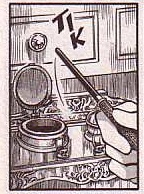 Emma first appeared in a seinen magazine in Japan, and Mori nods to her male audience in subtle ways. Her gaze dwells lovingly on William’s haberdashery: His shoes, the writing paraphernalia on his desk, even the way his carelessly folded jacket falls onto a chair. Beyond that, the story shifts frequently between William’s point of view and Emma’s. The leading male is often a cardboard character in romances, but William has real emotions. It’s easy to see that this manga was written to be read by men as well as women.
While Emma certainly has a gripping story, the art is the real draw. It’s interesting that Mori, who had never been to England when she started the series, can evoke Victorian England so well. It’s an idealized version, to be sure. The rooms would be much smaller and darker in a real Victorian house, and people didn’t parade around naked as much in the days before central heating. But that’s poetic license. The atmosphere Mori creates, from the busy streets of London to a close-up of a filigreed inkstand, is convincing and inviting.
 Her one weak point is faces. Almost everyone in Emma has the same face, and it’s a strange one: an underdeveloped nose that appears to be melting into the smooth curves of cheeks and chin, a tiny mouth that is often just a single line, and some of the oddest eyes in manga-dom. The eyes are big, and they have the requisite highlights, but viewed from the side they appear concave. Emma’s German employers and their staff have more distinct features, but among William and his circle, I sometimes had to look closely at details of the costumes or hair to figure out who was who.
Mori clearly enjoys drawing the female figure, and some of the panels, such as the nude scenes later in the series, look like they could have been drawn from life. Her figures have a solidity that is unusual in any comics, manga or otherwise, and their movements seem natural and relaxed.
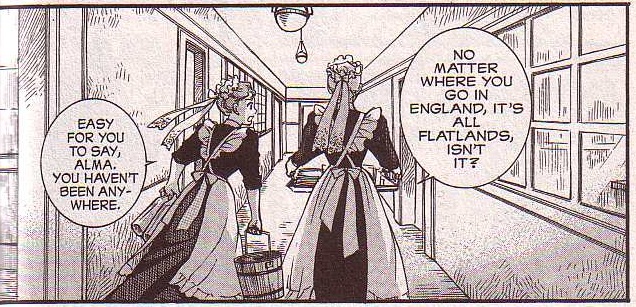
Each panel of Emma is as detailed as an illustration in a Victorian picture book, and Mori’s technique even mimics the parallel-line shading of old engravings. Yet the meaning never gets lost in the detail. She uses toning to subtly to set off single areas of shade and keep the hatching from blending into a single unreadable web, and particularly in the below-stairs scenes she uses the flowing black curves of the maids’ uniforms to punctuate the scene and draw the eye forward. Mori breaks her story up into many little panels, often fitting six or more onto a page, but the art never seems crowded; even the small panels are clearly composed, and they often have a monumental feel despite their jewel-like size.
Reading Emma is like stepping into another time and place. While the story alternates between breathless and listless, the little dramas of everyday life in Victorian times lift this book from good to great.
This review is based on a complimentary copy and galleys supplied by the publisher.
 Toto! The Wonderful Adventure


