Three years and counting

Yep, it’s MangaBlog’s third birthday today, which means I’m about a year or so away from becoming a grizzled internet veteran. So thank you for reading—you are the reason I show up to blog every day.

I want to start with an opportunity for the other bloggers out there—Adam Arnold of Seven Seas e-mailed me to let me know that they are looking for anime and manga bloggers to review their new light novels. Check their site for more info.

Also, I’m happy to announce the latest convert to our numbers: Stan Lee, who will be teaming up with Shaman King creator Hiroyuki Takei to produce a manga for Shueisa’s Jump Square Second. Yeah, that’s right, it’s going to be in Japanese. ANN also has news of a new one-shot manga from Mohiro Kitoh and the imminent demise of Prince of Tennis, Muhyo and Roji’s Bureau of Supernatural Investigation, and Kamichama Karin -chu-.

Weekly Recon moves to Mondays so we can more efficiently plan our spending for the week. Katherine Dacey celebrates with an extra helping of reviews. And for those who really like to think ahead, MangaCast lists May and June releases culled from Diamond Previews.

Johanna Draper Carlson takes a critical look at some of Tokyopop’s global manga.

Business Week reviews Daniel Pink’s manga career guide, The Adventures of Johnny Bunko. The first chapter is available as a PDF here. (Via Do You Sociate?)

Jason Thompson holds a manga tasting.

At Manga Xanadu, Lori Henderson notices something odd about a take-down list.

John Jakala wonders about Death Note: How to Read at Sporadic Sequential. (Warning: spoilers.)

For those of you looking for Iris e-books: Kellie is working on it, but there has been a glitch.

ComiPress presents another chapter of Manga Zombie, this one a continuation of the article on Kajiwara Ikki.

New York San Diego Comic-Con has its own magazine, and it’s free on the web.

France’s Centre d’Etudes et Recherches Internationales will host a two-day conference on manga and anime on March 15-17.

Reviews: Let’s start with something different: Kethylia posts on some manga she’s not going to review. At Comics-and-More, Dave Ferraro reviews vol. 1 of Gerard & Jacques and vol. 9 of Nana. Ed Sizemore checks out vol. 1 of Ral Grad at Comics Worth Reading. Tiamat’s Disciple posts some first impressions on vol. 2 of Alice on Deadlines. Despite her best instincts, Erica Friedman can’t stop herself from reviewing vol. 2 of Eternal Alice Rondo at Okazu. John Thomas takes a hard look at vol. 2 of Translucent at Mecha Mecha Media. James Fleenor posts his impression of vol. 8 of O-Parts Hunter at Anime Sentinel. At the Manga Maniac Cafe, Julie checks out vol. 1 of Metro Survive, vol. 2 of High School Debut, vol. 1 of Monkey High!, and vol. 9 of Nana. Holly Ellingwood eyeballs vol. 4 of Kurohime, vol. 24 of Prince of Tennis, and vol. 1 of Monkey High! at Active Anime. Tangognat reviews vol. 3 of Yurara, vol. 1 of Aria, and vols. 1-4 of Dokebi Bride. Greg Hackmann checks out the Sgt. Frog omnibus at Anime on DVD.

Posted in Mangablog | 28 Comments

PR: New volumes from DrMaster

Below the cut, the hot skinny on the latest volumes from DrMaster, including a new series, yet another entry in the trapped-in-the-subway genre that is so popular in Japan.

HOT OFF THE PRESS!!!
LUNAR LEGEND TSUKIHIME VOL 5, CHINESE HERO VOL. 5, AND METRO SURVIVE VOL 1, AVAILABLE NOW!!!

feb2008pr.jpgSAN JOSE, CA – March, 2008 – DrMaster has just announced the publication of Chinese Hero: Tales of the Blood Sword volume 5 by Wing Shing Ma, Lunar Legend Tsukihime volume 5 by TYPE-MOON and sasakishonen, and a new series by Yuki Fujisawa, Metro Survive volume 1.

Chinese Hero vol. 5
Hero defeats Steel Bull and rescues the captured people in Steel Bull Valley. However, before dying, Steel Bull lets out a battle cry, calling a stampede of mad bulls charging into the valley and furiously attacking everyone. The crazed bulls are eventually defeated, but with tragic consequences… While Hero is trying to get back to China Tower, he meets a soothsayer who tells him that he is going to be lonely for the rest of his whole life. Hero sees this as a dark omen of more unfortunate events to come… Meanwhile, China Tower is attacked while Hero is gone, and Zhi, Qin and Ghost Servant fight for their lives as they desperately try to fend off the Black Dragon Gang. Will China Tower be crushed? And will Zhi, Qin and Ghost Servant come out alive? Find out what happens in this action-packed volume of Chinese Hero!

Lunar Legend Tsukihime vol. 5
After rescuing Shiki from his dangerous encounter with Roa, Ciel warns him in vain to stay away from Arcueid, who may have an ulterior motive. Meanwhile, Shiki cannot shake off the feeling that he knows Roa, and a visit to the garden of his house jolts his memory, piercing him with visions of Roa as a child, along with a voice telling him that he will become a “true monster” someday.

Metro Survive vol. 1
Mishima is your average spineless pushover, working as a repairman for the Exopolis Tower, Tokyo’s largest and hottest high-rise business and entertainment building. He promises to come home in time to celebrate his son’s birthday, but when he lets his pushy boss saddle him with overtime, the task takes him all night. On the morning subway train heading home, a massive earthquake strikes and collapses both Exopolis and its underground train lines. Now Mishima is trapped deep underground with the other passengers of the train, some of whom are less than cooperative. Will he be able to take the initiative for once and lead them all to freedom, or will they starve in their underground prison?

Availability
The three titles are available NOW. Chinese Hero: Tales of the Blood Sword vol. 5 will be priced at $18.95. Lunar Legend Tsukihime vol. 5 and Metro Survive vol. 1 will each be priced at $9.95. Visit www.drmasterbooks.com for more detailed series information.

Posted in Mangablog | Comments Off on PR: New volumes from DrMaster

Review: Two from Deux

Deux, the yaoi imprint of Aurora Publishing, has been cranking out titles at a pretty good clip, so I decided to check out two of their more likely-looking volumes. I’m not a yaoi reader, so my thoughts are more on the books as manga than as part of the genre. Both are rated M, mature, and priced at $12.95.

Cover: Yakuza in Love, vol. 1Yakuza in Love, vol. 1, by Shiuko Kano: Stylish, but hard to follow, tale of love among the ranks of organized crime. Lead character Aoi Ichimura has a cross-shaped scar on his face and a reputation as a badass, but underneath it all he’s a lovable wimp who happens to be extremely lucky. While dodging to avoid stepping on a baby bird, he bumps into The Don, knocking him away from a hitman’s bullet. As his reward, he is made the apprentice to underboss Yuji Sakiya, who is more the strong, silent—and competent—type. The attraction is instantaneous, but despite the fact that other members of the Yakuza are happily bonking each other all over the book, Aoi is reluctant to show his affection. There’s a real plot, involving the organization’s shift from its previous enterprises to porn and slavery, a rival gang’s attempt to muscle in, and plenty of double-crossing. I found the opening sequence confusing, but after a while things started to fall into place. Still, the story was disjointed enough that I was relieved to find the character profiles at the end, which helped me sort a few things out. The art is slick and elegant, and if broad-shouldered, well-dressed men are your type, then this is the book for you.

Cover: Hate to Love YouHate to Love You, by Makoto Tateno: The cover trumpets this as “a yaoi version of Romeo and Juliet,” but the chief similarity is that the two protagonists come from feuding families, which is only the starting point of Romeo and Juliet. The whole web of love, deception, and death that Shakespeare used to fill up the rest of his pages is noticeably missing from Hate to Love You, and Tateno’s work contains something the bard neglected to include: a seme and a uke. The Konoe and Kazuki families both own construction companies and have been feuding for generations, and high school students Masaya Konoe and Yuma Kazuki are continuing the tradition. The story is told from the point of view of Masaya, who is frustrated because Yuma is better than him at everything, from grades to getting the girl. Yuma is the cool one, except when he gets passionate with Masaya, while Masaya is all emotional and bothered and can’t do anything right. I actually found the most likeable character to be the girl who connects the two, Akiko Tojoin. She’s a smart, sympathetic character who brings the two families together, literally and figuratively. This one-shot story wraps up in only four chapters, so Tateno fills out the book with a rather creepy short story about a kid who stalks a grownup and winds up getting more than he bargained for. Tateno’s fans seem to like her art a lot; I found her figures a bit flat in places, but her drawings have a dynamic quality that makes them work anyway.

A few words about production values: The Aurora/Deux folks are aiming a bit higher than most manga publishers in terms of paper and print quality. The first batch of books I saw from them, which includes Hate to Love You, was printed in China on paper that was very white and very stiff, which made their books hard to open—not unlike Broccoli Books were a year or so ago. The latest books, including Yakuza in Love, are printed in Japan on creamier, thinner paper that is still smoother and whiter than the stock used by most manga publishers. This makes the newer books easier to read, physically, but they also have an odd smell, possibly from the ink.

In terms of cover design, I like the Yakuza in Love better because it’s bolder and more graphic, plus I like the typeface they used for the title. On the other hand, the hot pink logo clashes with the rest of the art; it’s too bad they couldn’t modify the color. I’m not crazy about their back cover design, which is used for all their books—purple and pink type on a white background and an oversized logo, ratings box, and price tag all make the book look cheap, which at $12.95 per volume, it really isn’t. Still, if the worst thing I can find to say about a company is “I hate their back cover design,” they’re doing pretty well.

Posted in Reviews | 7 Comments

Devil's food

Quote of the day:

That’s right–the moral of Hell Girl is: “It’s OK to sell your soul for cake, and even more so if the cake is really good.” I never knew damnation could be so delicious.

Isaac Hale, reviewing vol. 1 of Hell Girl at PopCultureShock’s Manga Recon blog

Let’s start with a little shameless self-promotion: At Digital Strips, I interview Claudia Davila, creator of Luz: Girl of the Knowing, a cheery webcomic about a child adjusting to life after Peak Oil. No, really.

David Welsh peers into the future via this month’s Previews and finds plenty of manga competing for his dollar.

Deb Aoki talks to yuri maven Erica Friedman and the editors of the Gothic and Lolita Bible at About.com.

Back home at Okazu, Erica rounds up the latest yuri news and posts a handy manga glossary.

Lots of news at MangaCast: New releases from DrMaster, Pop Japan’s doujin tour, and the gang combs through the week’s new manga. Also: Ed says “Eh??” to Infinity Studio’s announcement that their e-manga is going to be on DVDs. Simon Jones has more thoughts on this at the Icarus blog (NSFW), and Ed chimes in in the comments.

John Jakala wonders what female manga readers think about fanservice.

Magnolia Clark has an interesting essay on the image of vampires in manga and anime at The Llwewllyn Journal.

Sad news: After over two years of covering the heck out of yaoi, Jen Parker and Jordan Marks of Yaoi Suki are hanging up their keyboards. The archive will stay up so the reviews will still be available, but we will miss their extensive coverage of the yaoi world.

Kindle phreaks? Lori Henderson finds the Kindle e-book reader has some hidden capabilities that may be of interest to manga readers.

The Expositor (“Serving Brantford and area for over 150 years”) takes a manga-tinged trip to Japan.

Panties and chainsaws: A winning combination? Canned Dogs takes a peek at Negative Happy Chainsaw Edge, by the author of the Welcome to the NHK novel.

Deutsche Manga has news of American licenses of German titles. And she’s making comics of her own! And another German Blog, Manly Manga and More, is back with March releases and a shopping list.

The deadline for The Original Manga Competition in Malaysia is March 15.

Sakura at Starbucks?

Reviews: Dan Grendell’s Manga Zubon column includes brief reviews of February releases at Comic Pants. And EvilOmar posts more Midweek Manga Reviews at About Heroes. At Precocious Curmudgeon, David Welsh finds plenty to like about All Nippon Air Lines. Matthew Brady checks out vol. 6 of Monster at Warren Peace Sings the Blues. Anime Pulse has an audio review of Once Upon a Glashma and O-Parts Hunter. Kumi Matsumaru enjoys One Piece and Kitty Sensei finds vol. 1 of High School Debut a bit cliched at The Star of Malaysia. At Active Anime, Holly Ellingwood reviews vol. 4 of Somedays Dreamers, Body Language: The Novel, and vol. 3 of Translucent, and Davey C. Jones checks out vol. 7 of Air Gear. Lori Henderson critiques the January and February issues of Shojo Beat at Manga Xanadu. Johanna Draper Carlson takes a look at vol. 2 of Walkin’ Butterfly at Comics Worth Reading. Michelle gives high grades to vols. 2 and 3 of Maison Ikkoku at Soliloquy in Blue. At the MangaCast, Mangamaniac reviews Love Training, Aliera looks at some new shoujo titles, and Ed Chavez has an audio review of vol. 1 of Yozakura Quartet and vol. 7 of Nana. Lissa Pattillo reviews vol. 1 of Invisible Boy and Snow Wildsmith needs a flow chart to follow Party at Manga Jouhou. Lissa Pattillo reviews vol. 1 of Inu-Baka at Kuri-ousity. If you read French, check out Xavier Guilbert’s essay on Lady Snowblood at du9; if you don’t, just wait and hopefully he will translate it soon. James Fleenor checks out vol. 4 of Archlord at Anime Sentinel. At it can’t all be about manga, Cathy can’t resist All Nippon Air Lines. Connie whittles down the stack at Slightly Biased Manga, with reviews of vol. 30 of Dragon Ball, vol. 3 of Bastard, vols. 4 and 5 of Berserk, vol. 16 of Astro Boy, vol. 11 of Phoenix, vol. 6 of Enchanter, vol. 12 of Swan, and vol. 10 of Skip Beat. Kethylia reviews vol. 21 of Berserk.

Posted in Mangablog | 1 Comment

Review: MW

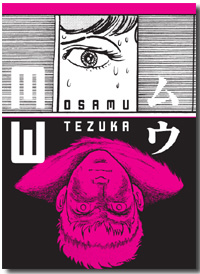
MW coverMW
By Osamu Tezuka
Rated 16+
Vertical, $24.95

The opening scene of MW reminded me of a cheesy cop show from the 1970s: A car on a lonely bluff over the ocean, a truck swerving in from nowhere, a kidnapping plot gone awry, helicopters overhead, guys duking it out on the deck of a motorboat. I kept expecting Tom Selleck or maybe Jill St. John to show up and join in, at least until things turned bloody at the end of the scene.

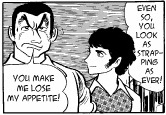
The unhappy coupleThat 70s vibe continues throughout the book. It’s partly cosmetic: chief villain Yuki Michio’s muttonchop sideburns and his stripey swingin’ bachelor pad never let us forget what era this is, and Michio’s chief pursuer is a flowing-haired detective who looks like he stepped out of a Peter Max painting. The story is slick and shallow with plenty of action to keep the reader involved. And while the book touches on issues that seem very contemporary—chemical weapons, the molestation of a child by a priest—these are merely story elements, dropped in without much commentary or angst.

It’s hard to summarize MW without making it sound more outlandish than it actually is: It’s about a serial killer who plans to annihilate the entire earth—and the priest who loves him. The story starts in the 1960s on an Okinawan island, where The Crows, a band of hippies straight out of Central Casting (headbands, love beads, vest worn over bare chest) kidnap a young boy, Michio, and send one of their number, Iwao Garai, to hide him in a cave. During the night, Garai molests Michio, and when they emerge the next morning, everyone else on the island is dead, stopped in their tracks by what we later learn is a deadly gas, MW.

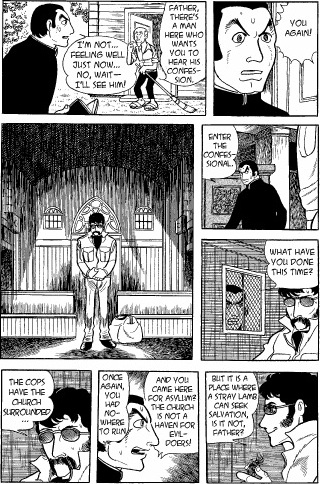
Church sceneWhile Garai is spared, Michio is profoundly affected, physically and mentally, by MW, which has apparently burned away his conscience. Tezuka skips the next 15 years and presents us with two characters who have apparently taken completely different paths: Garai is a priest, Michio works in a bank, where his planning abilities and utter cold-bloodedness are assets to his social and career climbing—and to his life of crime.

While some deeper themes are presented here, MW is really about watching Michio commit one heinous crime after another, pulling them all off with the same smirking competence. Eventually it becomes clear that Michio is targeting those responsible for the MW incident and the subsequent coverup, but this isn’t about revenge; Michio is dying, and he wants to take the rest of the world with him. And he’ll use MW to do it. Most thrillers have something strongly pushing the action forward; MW lacks that element of urgency until fairly late in the book, when the clock starts ticking and Michio is finally outwitted.

Opening sequenceTezuka has a great imagination, and he puts it to work devising an escalating series of adventures for Michio and Garai. That doesn’t mean he steers clear of the clichés of the genre: When a reporter hot on the trail of MW agrees to meet Michio alone, late at night, in a garage, we know he’s doomed. And some of Michio’s capers stretch even the credulity of a dedicated manga reader—such as when he murders a young woman, then puts on her dress and a wig and impersonates her so well that her parents are taken in.

Unfortunately, both main characters come across as pretty flat. Michio is so cold-blooded and depraved that he’s almost boring. Whether he’s dispatching his boss by hanging him from an iron bar and tossing lit matches in his face, setting up Garai in a gay sex club, or having sex with his dog, he does everything with the same smirking opacity, without ever slipping and showing us the inner man. Garai has a conscience but does little with it; the seal of the confessional provides a handy excuse for him to cover for Michio, but it’s harder to understand why he repeatedly accompanies him and gets drawn into the action. You’d think he would learn after a while that this guy is trouble.

Come hitherGarai and Michio’s affair is the cheesiest part of the whole book. Tezuka’s figures are so smoothly polished that the sex scenes look almost abstract, and Michio does most of his seducing chastely clad in underpants, which make him look more comical than come-hither. The biggest problem, though, is that Tezuka fails to establish a convincing emotional connection between Michio and Garai. The general pattern is: Michio does something horrible, Garai decides to take a stand, Michio thwarts Garai and then says “Oh come on, don’t be mad,” and they have sex.

The art in MW is smooth and straightforward, often dramatic but seldom outstanding. Tezuka is at his best when he’s working the whole page, and he has a few breathtaking turns here, but most of the time the action is contained in small panels and the illustrations are competing with the word balloons for space. And there are a few places where he just punts. You get the feeling his heart wasn’t in it for big stretches.

Nonetheless, Vertical gives this volume the full treatment: It’s beautifully printed on creamy paper, with a luscious black and white and magenta cover and dust cover by Chip Kidd. The artwork is flipped, which doesn’t hurt the story much, and sound effects are translated and retouched so as to become part of the art.

MW reads pretty well as a caper story, not so well as literature. It’s entertaining enough to watch Michio pull off one clever but improbable plot after another, but he never really gets under your skin, and neither do the other characters. It didn’t make me lose my religion, but it did keep me entertained enough not to want to put it down, which after all is exactly what comics are supposed to do.

This review is based on a complimentary copy supplied by the publisher. All images copyright (c) Tezuka Productions.

Posted in Reviews | 4 Comments

Friday early links

Yen Press finally got a real website! The basic design is nice and clean, although the miscellaneous logos for different books clutter it up a bit—the armchair designer in me wants to replace those with titles in a single type plus cover shots. A couple of the links have no content yet, but I’m happy to see there is going to be a blog, and I notice there’s a “downloads” button as well. Hmmm.

David Welsh discusses where he buys his manga at Precocious Curmudgeon, and lots of people chime in with their comments.

ComiPress translates another blog post about hard-working manga artists; this one is about George Akiyama, who doesn’t seem to have anything translated into English, although Pseudo-Human Gourd Beetle sounds promising.

Imprint TALK has a post on the popularity of manga in Japan, including shots of folks reading on the train.

Pablo Hidalgo compares different comics adaptations of Star Wars, including Marvel and manga versions. (Via ComiPress.)

News from Japan: Canned Dogs reports that Shounen Magazine and Shounen Sunday will start a new biweekly magazine that will run popular chapters of Detective Conan (a.k.a. Case Closed) and Kindaichi Case Files. ANN has more, including the news that the new magazine will be called Conan & Kindaichi. ANN has the news that Girls Bravo mangaka Mario Kaneda will start a new manga serial in Kadokawa Shoten’s Monthly Shonen Ace. And I guess this was inevitable: schoolboy cafes.

Manhua! China Comics Now is an exhibit that will open in London on March 7.

NYCC news: ICv2 has announced their panels for the pre-show conference, which has proven to be one of the best parts of the whole experience for me.

Reviews: John Jakala runs through what he’s been reading lately at Sporadic Sequential (warning: includes image of homicidal Santa). Ed Sizemore reviews vols. 1 and 2 of Zondervan’s Manga Bible (not to be confused with Siku’s The Manga Bible) and vol. 1 of Le Chevalier d’Eon at Comics Worth Reading. Danielle Van Gorder checks out vol. 1 of Wild Ones, and the whole staff pitches in with the Small Bodied Manga Reviews at Anime on DVD. Michelle moves on to vol. 4 of Boys Over Flowers at Soliloquy in Blue. Holly Ellingwood reviews vol. 7 of Beauty Pop and vol. 13 of Black Cat, and Sandra Scholes has an advance look at vol. 1 of Kingdom of the Winds, at Active Anime. Tiamat’s Disciple reads vol. 2 of With the Light. Nick is of two minds about vol. 1 of Harukaze Bitter Bop at Hobotaku. At Manga Life, Ysabet Reinhardt McFarlane checks out vol. 1 of Suppli and vol. 26 of Basara, and James Hanrahan reviews vols. 1 and 2 of King of Thorn. Comic Pants presents another edition of Manga Zubon, their collection of brief reviews. J. Bowers takes a look at vol. 1 of Muhyo & Roji’s Bureau of Supernatural Investigation at PLAYBACK:stl. At Okazu, Erica Friedman is pleased with Voiceful.

Posted in Mangablog | 4 Comments